Completed Projects
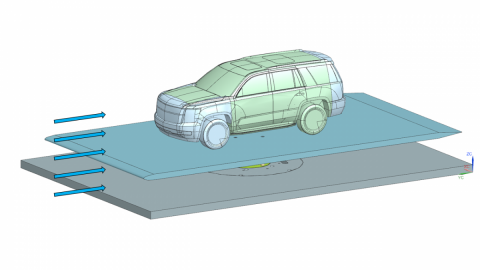
The main contributor to the drag on motor vehicles is pressure drag, which heavily influences the fuel economy of the vehicle as well. The pressure drag forms due to the bluff-body type shape of sport utility vehicles (SUV) which creates an adverse pressure gradient at the rear of the vehicle. Other key areas that highly contribute to the drag on SUVs are around the wheels and the underbody, including the front and rear bumper. These specific locations around the vehicle will be the focus for study during this research.
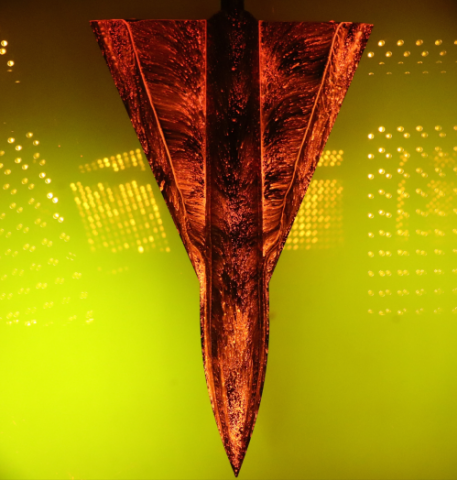
Fifth-Generation fighters such as the F-22 and F-35 favor chine-shaped forebodies which help reduce their Radar Cross-Section. The chine produces strong forebody vortices, which interact with the wing vortices. However, in certain conditions the interaction can produce asymmetric vortex breakdown, non-linear moments and roll departure. Future fighter aircraft will have this issue compounded as, to further reduce their RCS, future-generation fighter aircraft are projected to be tailless, sacrificing lateral control authority.
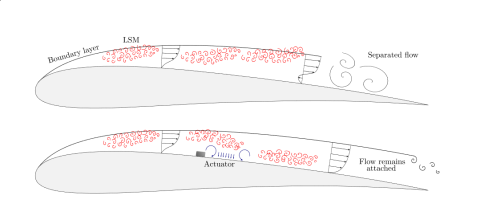
This project is part of a collaboration with researchers at the University of Texas at Austin ( David Goldstein , Saikishan Suryanarayanan and Efstathios Bakolas ) to reenergize boundary layers using naturally occurring coherent structures, or large-scale motions (LSMs). These LSMs are modelled as a train of hairpin vortices.
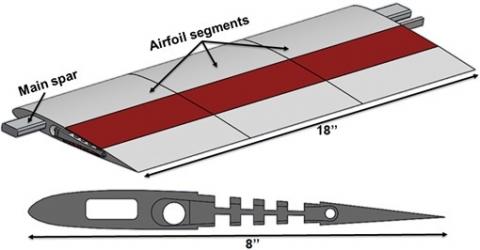
This project is a collaboration with RPI's Center for Mobility with Vertical Lift (MOVE) with contributions from Dr. Etana Ferede. In high speed rotorcraft applications, a large section of the retreating blade undergoes reverse flow due to a high advance ratio. Flow separation at the sharp aerodynamic leading edge during reverse flow (geometric trailing edge) leads to negative lift, pitching moment, and drag penalties.
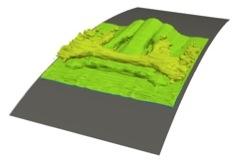
Experimental investigation of the formation of secondary flow structures and interactions of a finite-span synthetic jet in a cross-flow at chord-based Reynolds numbers between 50,000 and 400,000 and angles of attack from 00 to 200.
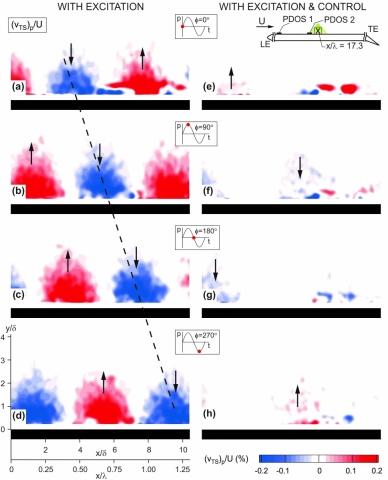
A turbulent boundary layer greatly increases the drag on a wing, and therefore aircraft fuel consumption. By delaying the transition of organized, laminar flow into disorganized, turbulent flow, billions a year can be saved in fuel costs. One way that this transition can be delayed is by using a vibrating surface element to suppress the Tollmien-Schlichting (TS) waves responsible.